Publishing
Publishing catalogs and datasets
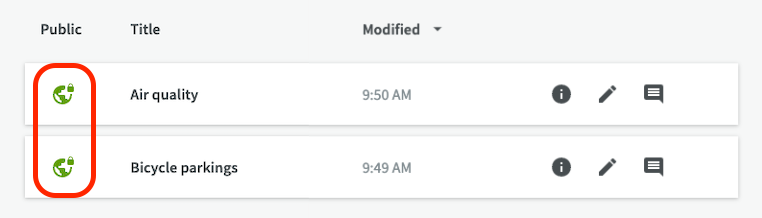
All newly created catalogs are private by default and therefore only explicitly assigned users may access and manage the catalog. In the list of catalogs, a green globe indicates that the catalog is published, meaning that the catalog’s metadata is publicly accessible and ready to be harvested by, for example, open data portals. A black crossed-out globe indicates that the catalog is not published yet.
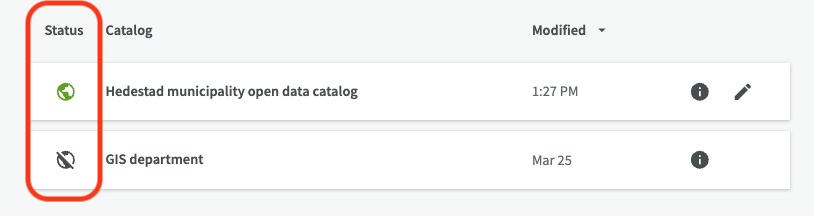
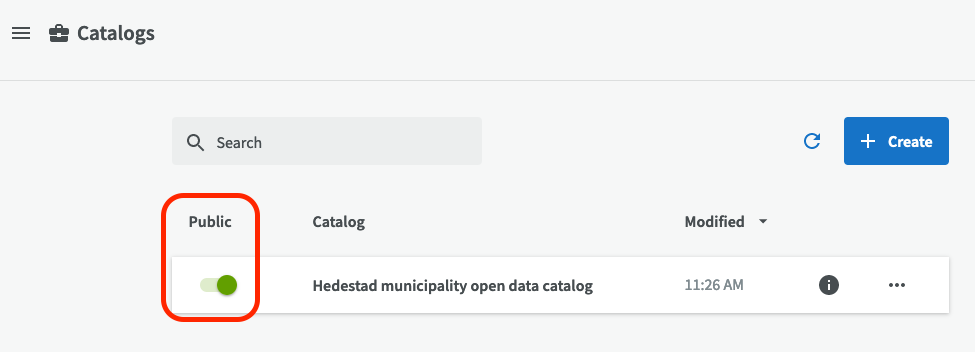
Using the publish button on the catalog’s overview page, you can publish or unpublish your catalog.
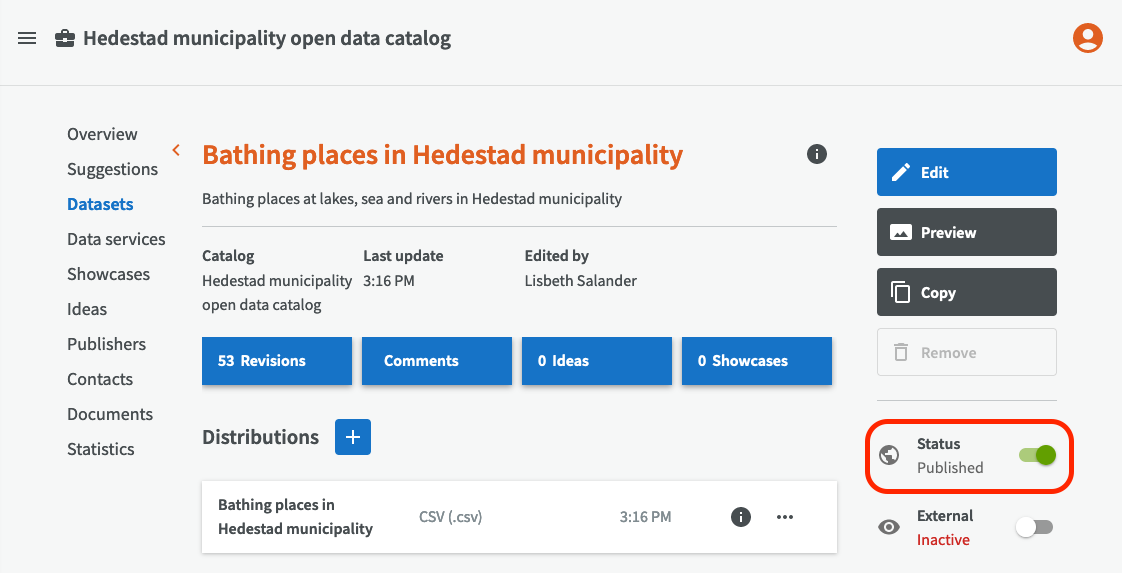
To be able to see anything in a published catalog, it must contain a dataset with a public status (listed publicly) or have external data harvest (to other data portals) enabled. You can manage publication status and activate/inactivate external data harvests on dataset level. Click on the publication button for the dataset to make it listed publicly and/or the external button to enable external data harvests.
Data services, showcases, and ideas are also published using the publish button on their respective overview page.
Internal publishing
As of version 3.15 of EntryScape, customers who want to be able to publish datasets internally can ask to get this functionality enabled. The publishing buttons will look slightly different, with internal status and external status. All externally published datasets are automatically published internally as well.
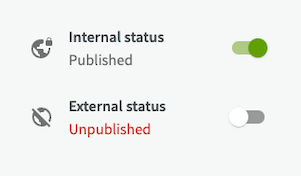
Datasets published internally are not externally visible, but anyone with an account on the same instance of EntryScape can view the dataset even if they do not have member access to the catalog. They can also only view the dataset, not edit it.
Internally published datasets are indicated by a small lock symbol on the globe icon.
Revisions
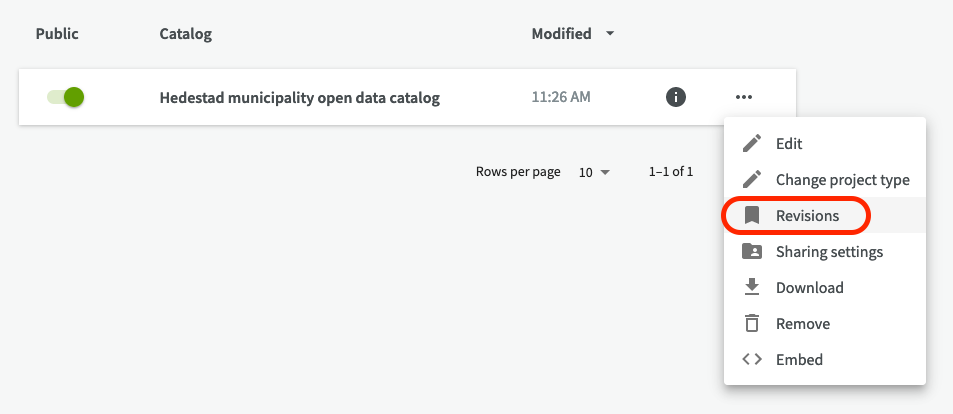
Some versions of EntryScape have automatic revision history of catalogs, datasets, distributions etc. You can access the revision history for a catalog, dataset, data service etc by clicking the button "Revisions.
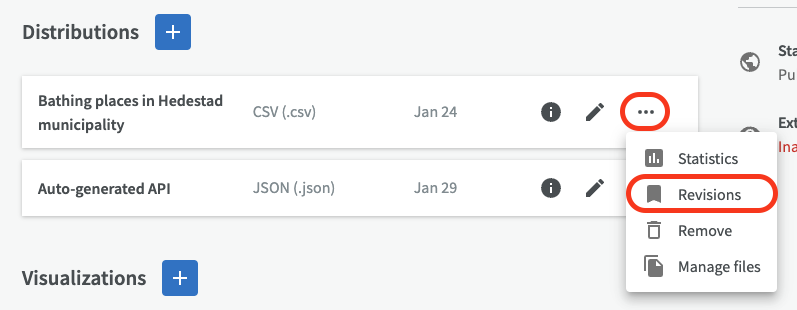
For distributions, you will find the revision history by clicking the three-point menu and choose "Revisions".
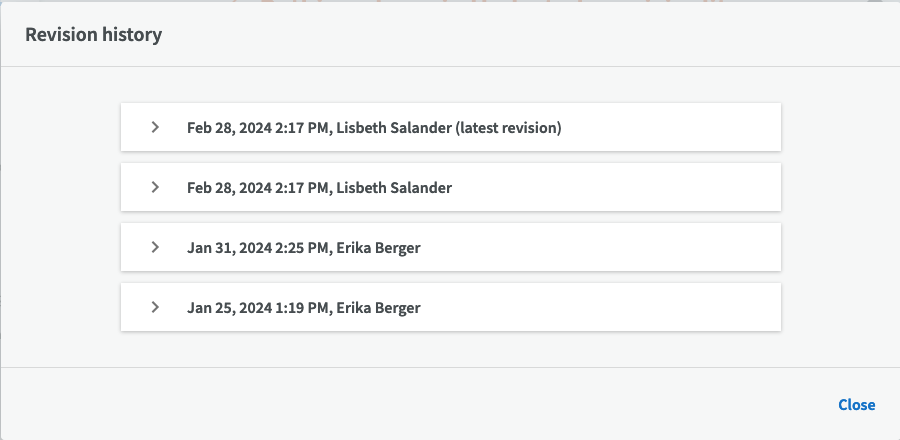
If you are a group manager or admin, you can use the Revision history to roll back/restore and earlier version of metadata description for the chosen entity.
For example, if someone has added or removed a dataset in a catalog, it should be visible in the revision history with date, time and name of the user who did the change. Ordinary members can see the different versions as well, but they can't do roll backs/restore older versions.
Embedding
When you have one or more published datasets, dataservices, visualizations etcetera in a catalog, you can embed them on a webpage, for example on a blog post, press release or other web page. With the embed function you can generate website code that you can copy and paste into external web pages.
EntryScape 3.20 includes a new, more advanced embedding feature that provides a better preview of how your data will actually appear on your website.
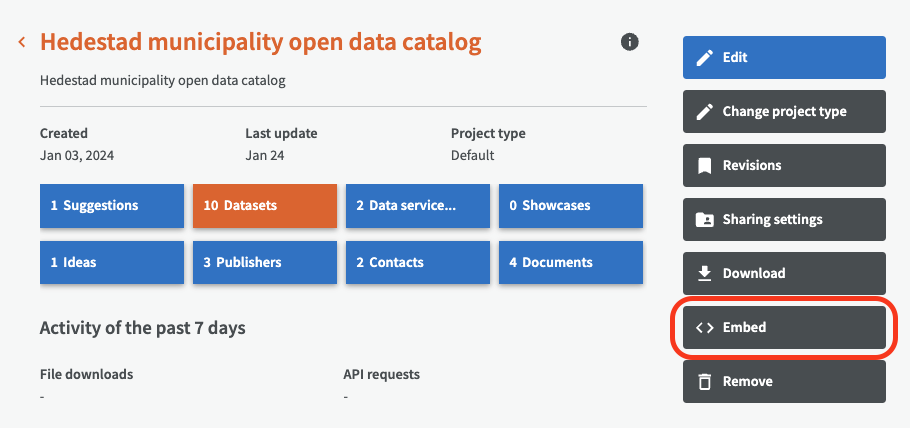
On the overview page for your catalog, click the "Embed” button.
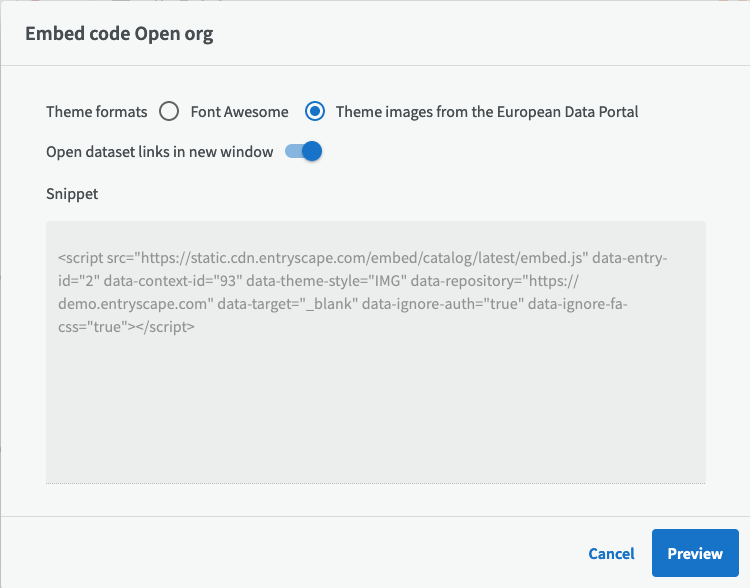
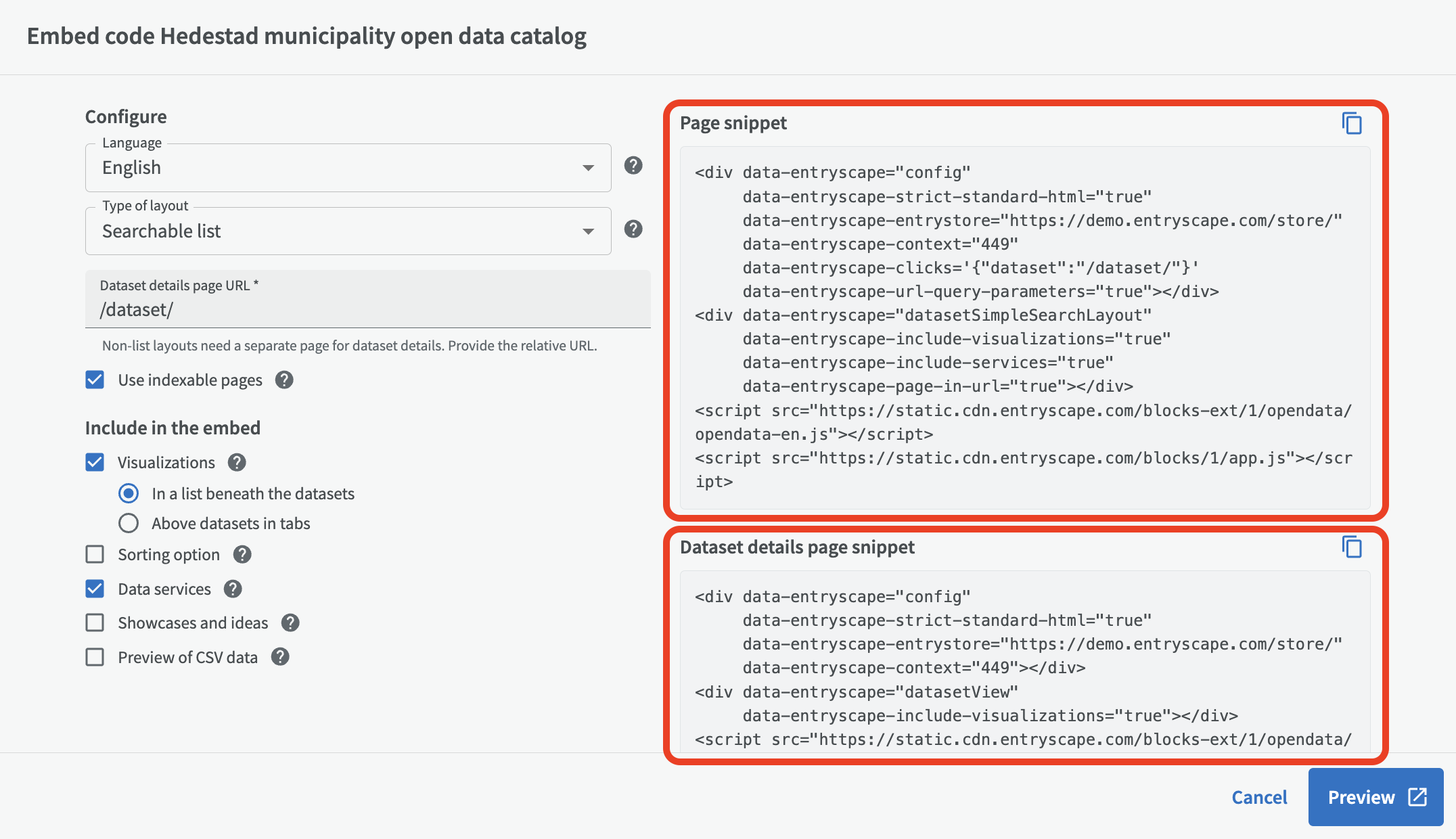
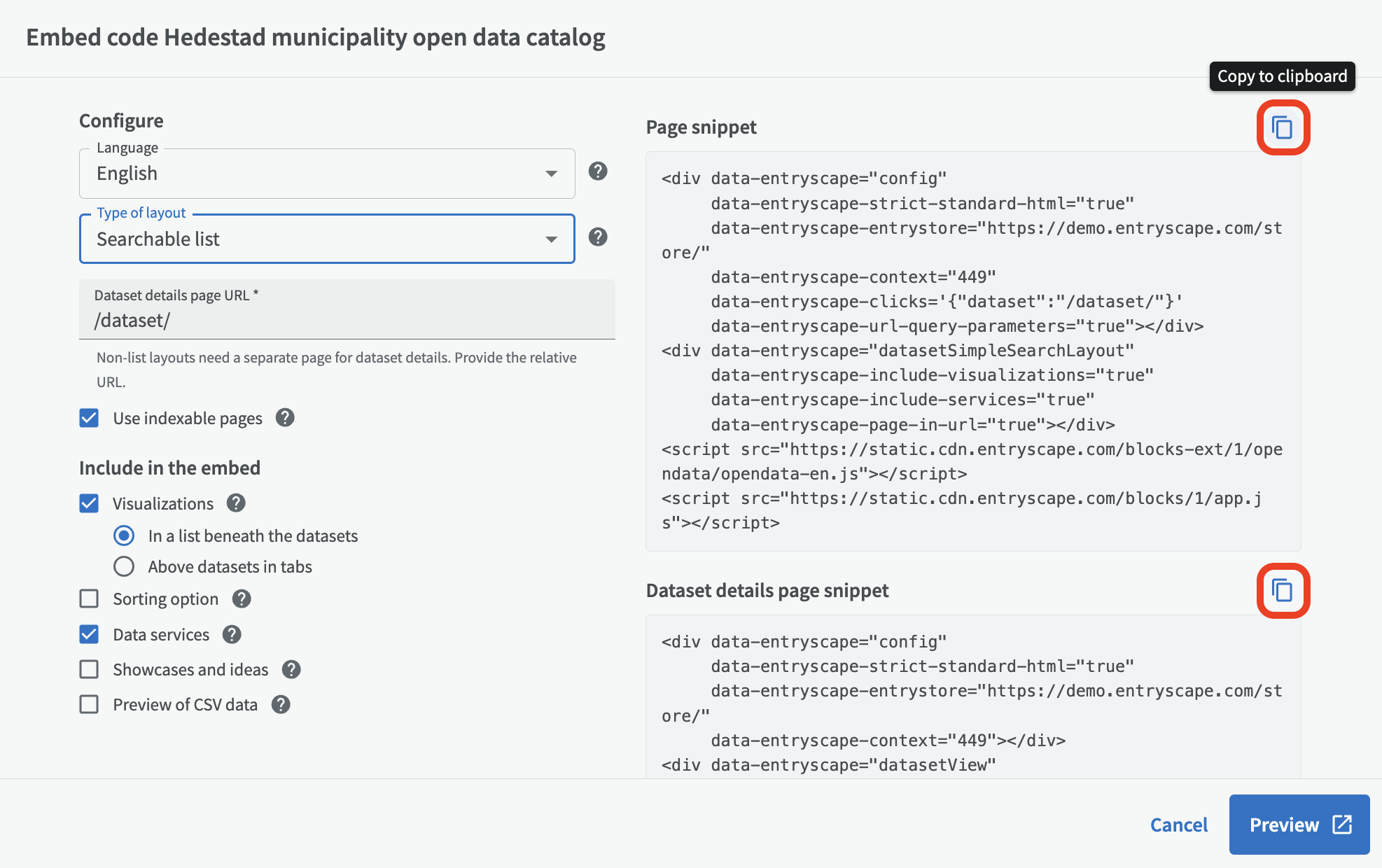
Next, you get a dialog where, on the left side, can choose what to display, what type of layout to use, and what language to display it in. The code that is generated by your choices is displayed on the right side.
Under "Type of layout", you can choose whether to display everything on a single page or split it across two separate pages; one for the list of datasets and more, and another for the individual dataset information. You can also choose whether the list should be searchable in different ways. If you want to display everything on a single page, select the List layout. You’ll then see a box with copyable HTML code on the right-hand side.

If you want to display the information on two different pages, with the list of datasets on one page and information about individual datasets on another page, select one of the other layout types, such as "Searchable List". Then HTML code will be generated in two separate boxes on the right-hand side. Under "Page snippet", the code for the list of datasets is displayed, and under "Dataset details page snippet", the code that generates the display of an individual dataset is shown.
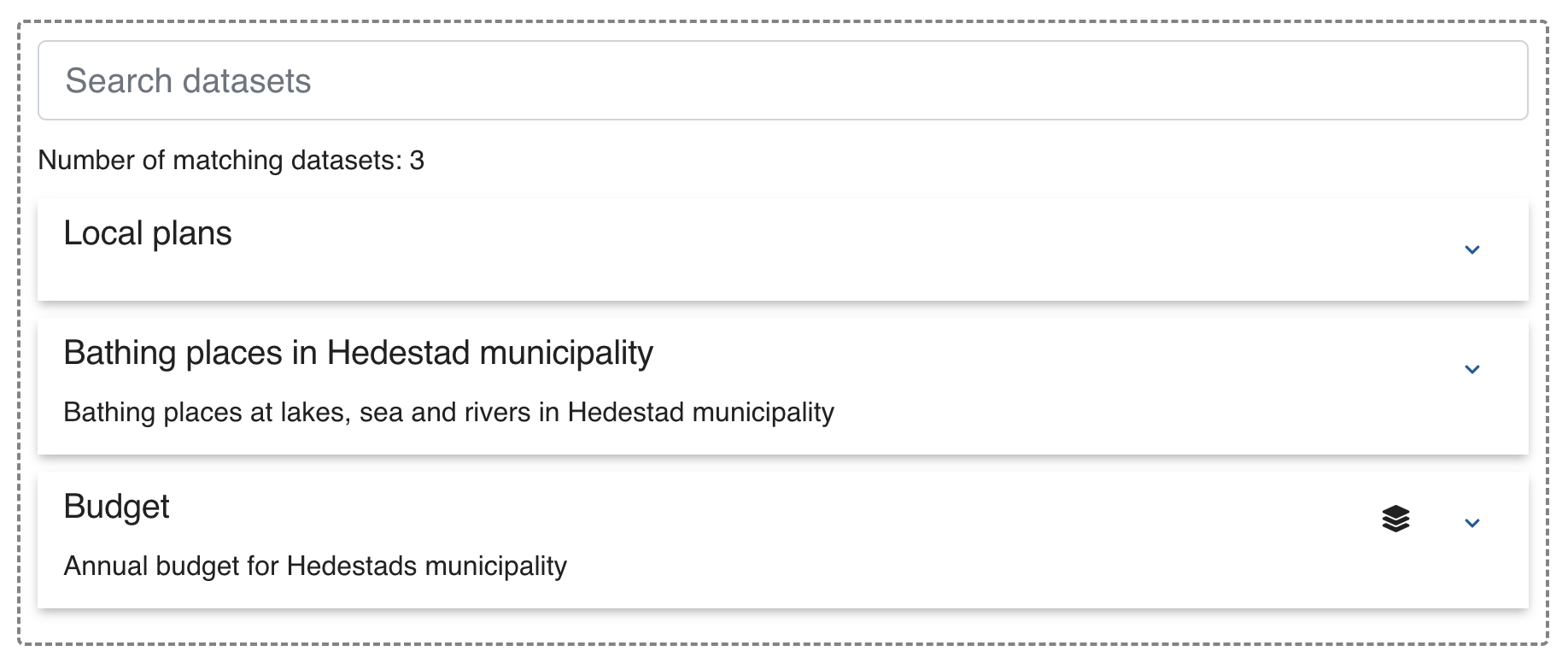
If you click the Preview button and scroll down a bit on the page that opens, you'll see what the list of your datasets etc. will look like.
If you then click on one of the entries in the list, you'll see a preview of a specific entry.
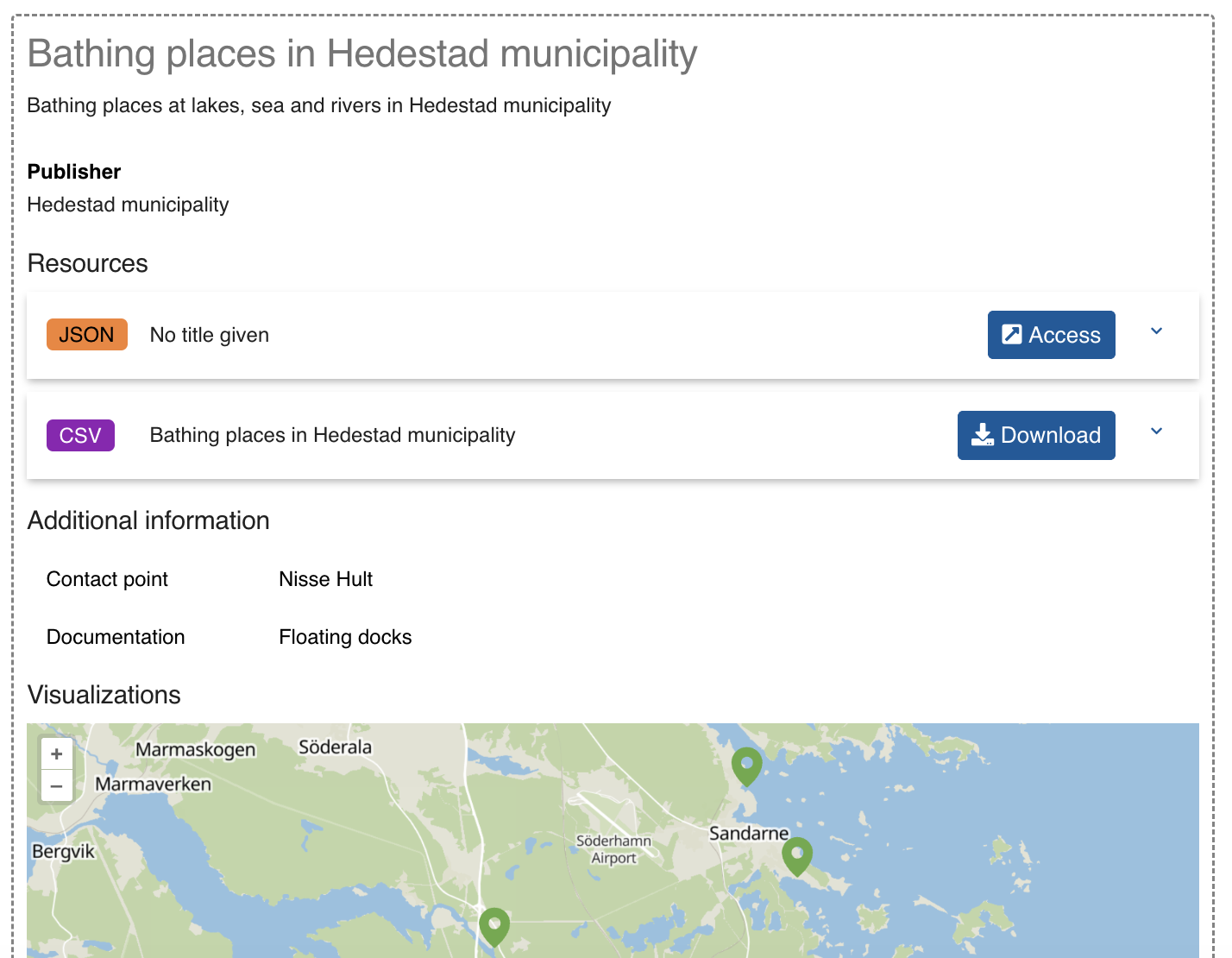
This way you can test different layouts. Once you’re satisfied with your choices, go back to the tab with the website code. Copy the code by clicking the copy icon for each code snippet in the upper-right corner. Then paste the code where you want it in your own website editor.
You can also embed the catalog view on the intranet, which can be useful for data that needs to be shared but should not be published as open data. Just follow the same steps as above.
Note: If no data is displayed where the code is embedded, your website’s Content Security Policy may be blocking the EntryScape scripts, or the EntryStore API may not allow requests from your website’s domain (CORS). In that case, contact your administrator.